|
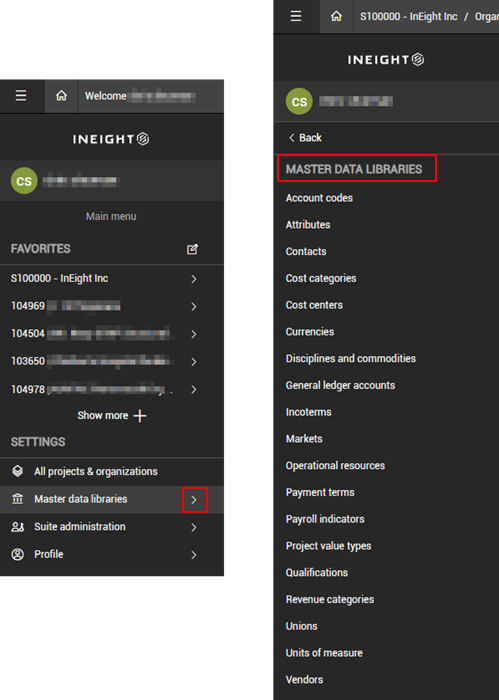
Account codes
|
Codes that are generally dictated by the specifications of accounting and ERP systems, and serves as a standardized coding system to track like operations across a company for the purpose of global reporting and benchmarking.
|
| Attributes |
Used in data fields that can be associated with project values, disciplines, and commodities, then assigned to a project to help organize and store pertinent information used for filtering and reporting. |
| Contacts |
A list of first and last names and other contact information that can then be associated with a vendor. |
| Cost categories |
Default categories in Platform master data that are used to categorize costs by different criteria. Cost categories are tracked for reporting and benchmarking purposes, which can help understand the sources and effects of costs, to plan, control, and evaluate the performance of a project. |
|
Cost centers
|
Cost centers typically represent business units. These cost centers allow you to further define your integrated data.
|
|
Currencies
|
A list of all currencies your company can use, including both system created and user-defined currencies that can be used for various business functions in the InEight cloud platform applications and associated to projects.
|
|
Disciplines and commodities
|
Disciplines represent the different types of construction work, which can include many things such as architecture, engineering, project management, electrical, and facilities management. Commodities represent the materials, objects or products used in construction work such as concrete, steel beams, and gravel. These items along with their associated attributes data fields are then assigned to a project to help organize and store pertinent information used for filtering and reporting.
|
|
General ledger accounts
|
The main accounting record for your organization, consisting of a collection of account categories used for tracking and reporting on the financial transactions across the entire company.
|
| Incoterms |
Provides a set of terms established globally to clearly define who is responsible and for what when trading goods. |
| Markets |
In general, markets can be categorized into different types based on varying factors such as geographic location, industry type, product type, customer segment, in addition to the different stages of the construction process. |
|
Operational resources
|
Provides a standardized list of all operational resources. These resources are the specific employee, equipment, and material used to build and work on the project, which can then be tracked.
|
| Payment terms |
Provides a standardized list of the conditions set between subcontractor and owner or contractor for how and when payment for goods or services will be made, such as net 30 and pay when paid. |
| Payroll indicators |
Includes allowances, employee premiums, and attendance types, which provides a means to give more information about an employee’s compensation for the workday. |
| Project value types |
Represent the different entities common in construction and engineering work. The system managed project value types include Area, Segment, System, Subsystem, Turnover package, Construction commodity, and Work classification. Project value types with their associated attribute data fields are configured at a project level to help organize and store pertinent scope information used for filtering and reporting. |
|
Qualifications
|
Used to assign inspection tasks to people or equipment.
|
|
Revenue categories
|
A category to indicate a percentage probability that the change order will be reimbursed. The categories and probabilities percentages are set at the organization level and based on the organization's business rules.
|
|
Unions
|
Allows association of master data employees or crafts to a local union as required by the organization.
|
|
Units of Measure
|
Includes all units of measure your company can be used in organizations and projects.
|
|
Vendors
|
A list of records and their associated details, vendors can be defined as contractors, subcontractors, or suppliers your company works with to complete work on a project.
|